
What students can do
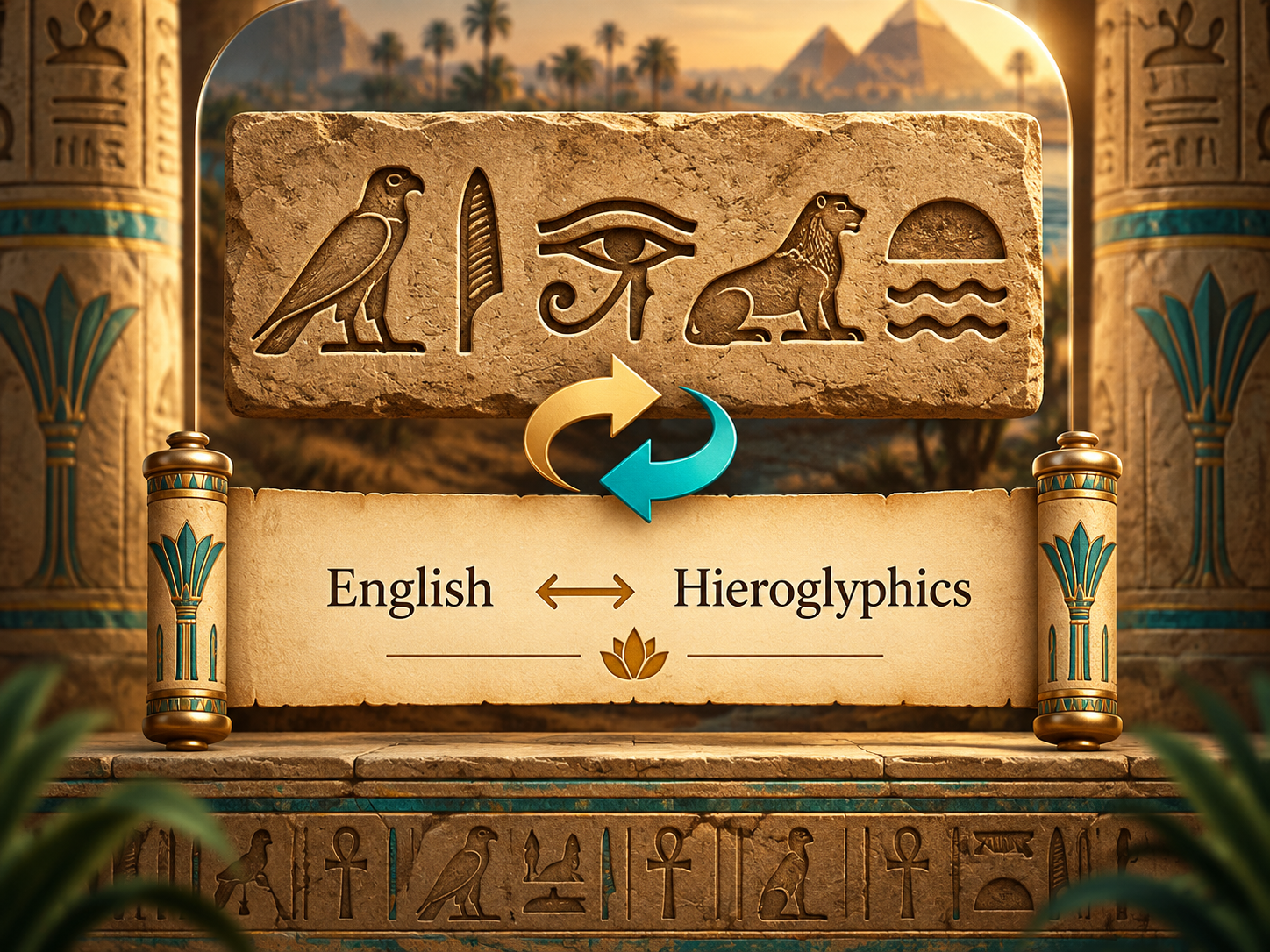
A classroom exploration tool that models Egyptian signs as logograms, phonograms, and determinatives while allowing guided English-to-hieroglyphics and hieroglyphics-to-English exploration.
- English → Hieroglyphics mode
- Hieroglyphics → English guided reading mode
- Logogram, phonogram, and determinative options
- Glyph reference searchable by sound, meaning, category, or function
- Authentic Egyptian Unicode signs and explicit historical cautions about transliteration
Learning objectives
- Understand that Egyptian hieroglyphic writing was not simply English represented with pictures.
- Differentiate logograms, phonograms, and determinatives.
- Recognize the consonant-heavy nature of Egyptian writing and the limits of modern approximations.
- Use writing systems to discuss literacy, administration, religion, identity, and historical evidence.
Educational uses
Name experiment—with caution
Students enter names or short phrases, then identify which output is phonetic approximation rather than literal ancient Egyptian writing.
Sign-function sorting
Students use the glyph reference to locate examples of logograms, phonograms, and determinatives and explain the purpose of each.
Writing-system comparison
Compare Egyptian writing with cuneiform, alphabetic systems, or Chinese characters, focusing on what counts as sound, meaning, and grammatical information.
Decode-and-question
Students build a short sign sequence, examine possible readings, and discuss why a single sign can have multiple values and why context matters.
Suggested classroom lesson
A practical starting activity
Begin with the misconception “hieroglyphics are picture letters.” Students test that claim using the translator, then produce a corrected explanation using the three sign functions and at least one example from the glyph reference.
Assessment ideas
Students create a mini reference card with one logogram, one phonogram, and one determinative, defining each and explaining how the three functions can work together in a writing system.
Differentiation and extension
Use teacher-selected glyphs and a small vocabulary set for support. Advanced students can explore transliteration conventions, omitted vowels, multiple phonetic values, or the challenges of reconstructing pronunciation.
Historical and instructional caution
This is an educational exploration tool, not a complete scholarly translation engine. Egyptian was not English encoded with symbols, one sign can have multiple values, and Unicode display can depend on installed historic-script fonts.